This page is still being written.
Hearing the hippocampus
Neural data turned into sound: decoded position becomes pitch, so running sounds like a scale and replay like a quick arpeggio.
What it is
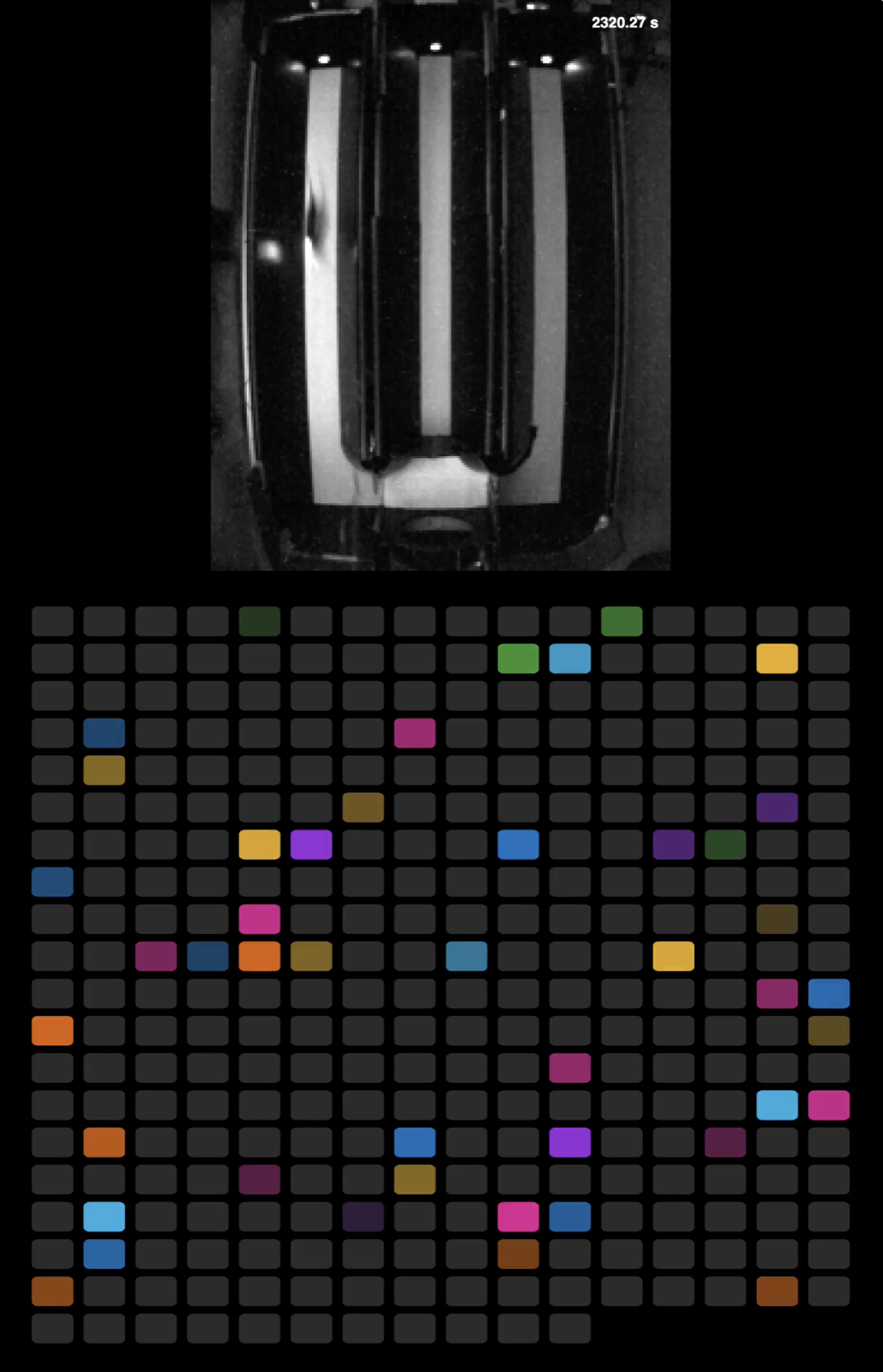
Sonification of hippocampal recordings from one session of the TADS task, synchronized with the behavior video. Sonifying the decoded position (rather than individual spikes) gives clean, musical results: a run down an arm is a smooth scale, and a replay event is a rapid arpeggio compressed into a fraction of a second. That makes replay speed something you can hear.
How it works
Coming soon.
Videos
Run and replay, as music · 25 s
A run down the right arm (an ascending scale), a replay of that path while the rat waits (a quick arpeggio), then the replay again in slow motion.
Every neuron at once · 2 min 16 s
All 315 recorded neurons as a grid of squares that light up and play a tone when they fire, next to the overhead video of the rat.
Spikes as notes, slow-motion replay · 14 s
An earlier, spike-based version: left- and right-arm place cells (the colored squares) play notes as a replay unfolds, slowed down.
Spikes as notes, approach and replay · 14 s
Right-arm place cells play notes as the rat approaches the choice point and a replay happens.
The first version · 1 min 4 s
Left- and right-arm place cells play notes as the rat runs the maze.
First test of the neuron grid · 7 s
A 32-neuron test of the grid display that became the all-neurons movie.
All 315 neurons, with a raster (5 s window) · 2 min 16 s
Every neuron as a click, with a scrolling spike raster showing the last 5 seconds.
All 315 neurons, with a raster (10 s window) · 2 min 16 s
The same, with a 10-second raster window.
All 315 neurons, with a raster (20 s window) · 2 min 16 s
The same, with a 20-second raster window.
252 neurons, quieter (5 s window) · 2 min 16 s
Interneurons and the noisiest high-firing cells muted, so the place cells stand out.
252 neurons, quieter (10 s window) · 2 min 16 s
The same, with a 10-second raster window.
252 neurons, quieter (20 s window) · 2 min 16 s
The same, with a 20-second raster window.
How it was made
Coming soon.
Links
- Inspired by ViSoND from the Smear Lab, University of Oregon